Did you know that this Regulation has been strengthened since May 1st, 2021?
The tyre labelling has been modified. This is a major step forward for the end-users as the new label provides clearer information on safety (tyre wet grip rating) and environmental parameters (fuel efficiency rating and tyre noise rating).
The EU tyre label guide below will help you to understand these changes to choose the best tyre for your usage.
EU tyre label guide
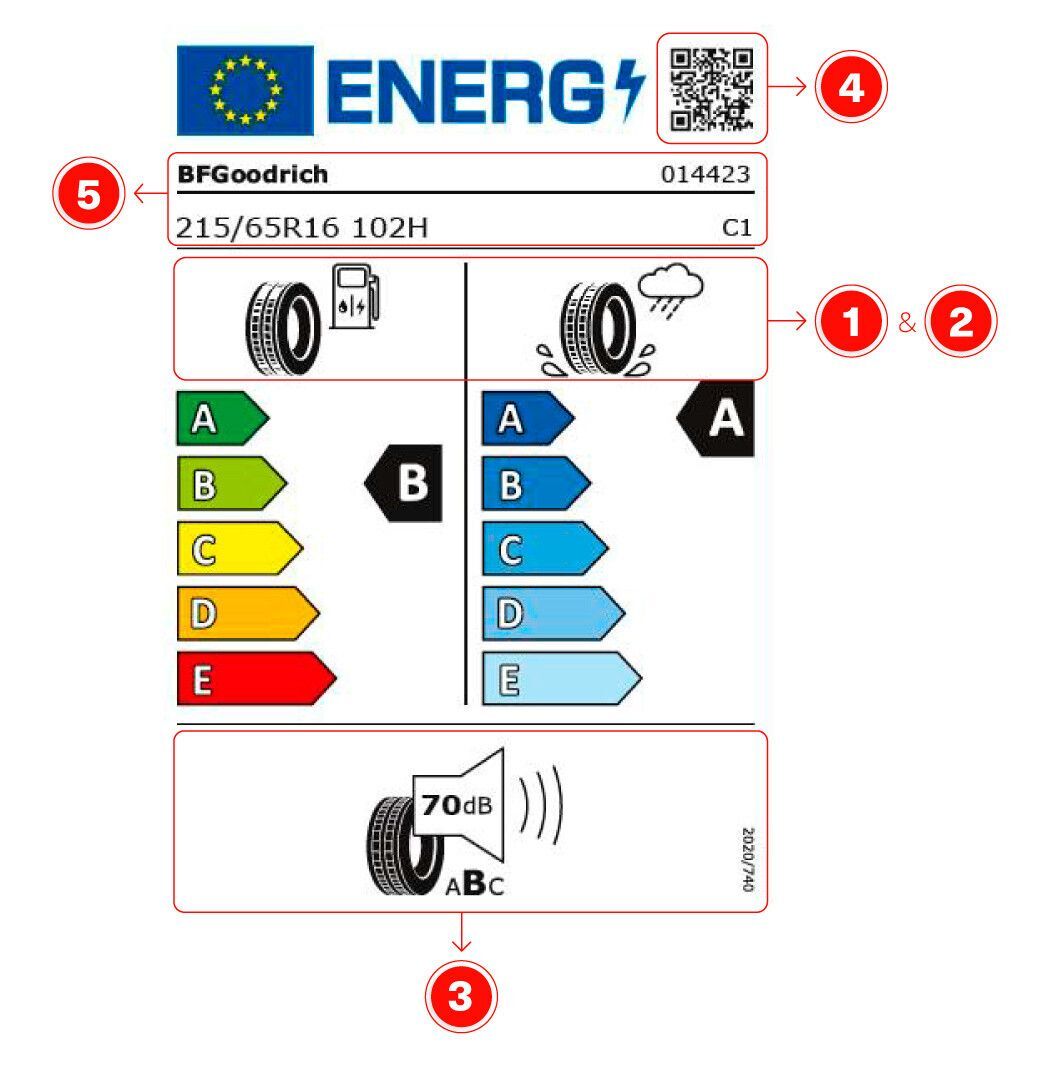
NEW EUROPEAN TYRE LABEL
1&2 – "Tyre fuel efficiency" and "wet braking" symbols classify the tyres between A & E (A being the most efficient tyre and E the least efficient).
3 – “External noise level” symbol is evaluated in decibels (db) and has 3 scales (A, B, C).
4 – The “3PMSF” and/or the “Ice grip” symbols can appear next to the “External noise” symbol when a tyre is eligible.
5 – A QR code is available to scan. It is directly linked to the European database (EPREL) and gives you all the information about the tyre label and the product information sheet.
6 – Brand name of the tyre manufacturer, tyre identifier reference, tyre size designation, tyre class.
Tyre efficiency indicator


The position of a tyre on these three scales allows you to have a factual information on its energy, safety and sound performance. It enables you to make the smartest comparison before you purchase your tyre.
A well ranked tyre will help you to improve fuel economy, save money while ensuring high safety and comfort level.
Why this evolution?
Dealer Locator
Search among our dealers to find where your tire is available
Tyre label indicators explained
Tyre fuel efficiency
This category represents the contribution of the tyre in fuel efficiency and greenhouse gas emission.
How does it work?
Tyres, mainly because of their rolling resistance (energy required by a tyre to keep it rolling), represent about 20% of vehicle fuel consumption.
Choosing a tyre with a low rolling resistance can noticeably reduce your fuel consumption and, consequently, reduce CO2 emissions.
How is it measured?
This rolling resistance value is measured on a simulation machine.
What difference between A-rated tyre compared to E-rated tyre?
172 £ (1) of fuel savings on average
Wet grip efficiency
The right part of the label represents the tyre’s performance on wet braking.
How does it work?
Being the only point of contact with the road, the tyre plays a major role in safety.
Its purpose is to grip the road in all circumstances (weather and ground surfaces).
How is it measured?
Measures are done on a vehicle, according to specific conditions defined by European Regulation (speed, track types, water depth, temperature…)
The grade is defined by comparing the performance of the tested tyre with a witness tyre.
What difference between A-rated tyre compared to E-rated tyre?
9 m(2)
External tyre noise rating
How does it work?
Tyre noise linked to road traffic is a major pollution.
This grading criteria gives you the tyre noise level (in Decibels), outside the vehicle (not the noise you hear inside your vehicle).
The letters A, B or C replaces the 3 waves (3 waves = C).
At a constant speed of 80 km/h, the noise generated by the tyre is usually superior to engine noise. This noise can also vary according to the road surfaces and the type of tyres you have.
An A-rated tyre is HALF NOISY than a B-rated tyre(3)
3 Peaks Mountain Snow Flake (3PMSF)
How does it work?
This symbol is for tyres that ensure real winter performance: they have been conceived for snow usage and they have met all the requirements defined during the testing phase (4).
30m(5)
Ice grip symbol
How does it work?
Having a good grip on icy roads is crucial to ensure safety.
The new "Ice Grip" pictogram is made for tyres with the shorter braking distance on ice. These tyres have been designed for road surfaces covered with compact snow and ice. They must only be used in severe weather conditions (such as in Nordic countries).
They should not be used in less severe weather conditions (warmer temperatures or wet conditions) as their performance can be sub-optimal (especially for handling, wear and wet grip).
Go further on road safety and fuel efficiency
It is important to be aware that fuel economy and road safety are also linked to driving behaviours:
Eco-driving is one of them and can significantly reduce fuel consumption.
Tyres’ inflating pressure must be correct and checked regularly to guarantee an optimum fuel consumption and wet grip.
Braking distances must be always respected.
As previously mentioned, the new EU tyre labelling is an important initiative which enables the drivers to better understand the real impact that tyre performance can have on their lives and on society as a whole. However, it does not cover all the demands expressed by consumers, nor all their uses.
Related articles
-
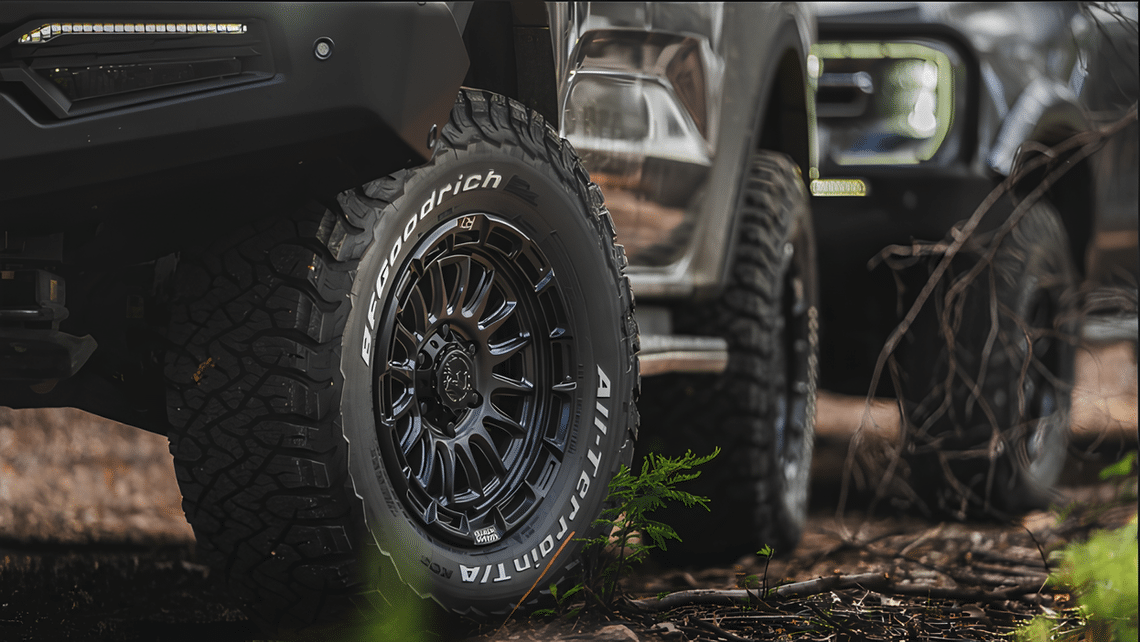
How to plan a successful 4WD trip
Australia's breathtaking landscapes beckon adventure, and for many, the best way to explore this beauty is in a four by four. But whether you're tackling muddy tracks or sandy beaches, a successful 4WD trip calls for preparation. Let's map out the steps to ensure your next off-road adventure is an unforgettable one.Learn more -

Complete tyre pressure guide for Australian terrain
Getting stuck in soft sand or losing traction on rocky climbs often comes down to one thing: wrong tyre pressure. This tyre pressure guide shows you how to adjust for various Australian terrain so you can tackle any surface with confidence.Learn more -

Why do you need BFGoodrich KO3 tyres
Off-road enthusiasts and everyday drivers alike understand the importance of quality tyres. When it comes to versatile performance both on and off the road, all-terrain tyres are the go-to choice. Let’s take a look at why these tyres are so great when it comes to driving on various surfaces and why BFGoodrich KO3 is what you need.Learn more
(1) Based on savings of 150 litres of fuel over a distance of 40,000 km at 1.15£ per litre (weighted average). The effect may change depending on the vehicle and driving conditions. Performance measured in accordance with the test method set in the regulation UN ECE R117.
(2) Performance of braking from 80 km/h to 20 km/h, measured in accordance with the test method set in the regulation UN ECE R117.
(3) Noise is measured on a vehicle travelling at 80 km/h with the engine switched off, measured in accordance with the test method set in the regulation UN ECE R117.
(4) Brake efficiency test under winter conditions according to the ETRTO method (European Tyre and Rim Technical Organisation).
(5) Average difference in the braking distance of a winter tyre compared to a summer tyre. Braking distance on a snowy surface from 50 to 0 km/h. TÜV SÜD 2013 tests, on 205/55 R16, conducted at -5°C.
(6) Performance of braking on ice from 20 km/h to 5 km/h, measured in accordance with the test method set in the ISO Norm 19447.